Subject index

Internet

9 talks · all topics

009 EN · 29 slides

Plone 5.2 migration at University Ghent, Belgium

The document outlines the migration process of Ghent University's website from Plone 4.3 to Plone 5.2 using Python 3, detailing various migration strategies, encountered challenges, and the involvement of a dedicated migration team. Key components include the use of ArangoDB for data migration, the creation of a custom migration script, and the need for extensive testing and quality control throughout the process. The current status indicates that content migration is almost complete, with ongoing tasks including testing and theme integration.


2019 ·Internet

893 views·slide text·original files

011 EN · 7 slides

Plone migrations using plone.restapi

This document discusses migrating 10 Plone sites from Plone 4.1/4.3 to Plone 5.1 using plone.restapi. The goals were a consistent look and feel, common code base with fewer dependencies, and consistent deployment. A custom provisioning API was built to handle site creation, content migration, and other tasks. The migration process extracted content from source sites and recreated it in the target Plone 5 sites using plone.api calls over HTTP. Most structures and content migrated automatically, with some manual work needed for default pages, collections, and other content. Lessons learned were that the approach was stable, reasonably fast, and could be adopted for other migrations.

2018 ·Internet

768 views·slide text·original files

012 DE · 5 slides

Plone Migrationen mit Plone REST API

Das Dokument beschreibt eine Migrationsstrategie für Plone-Websites mithilfe der Plone REST API, die eine Konsolidierung der inhaltlichen Typen und Add-Ons von 25 auf etwa 8 vorsieht. Die Migration erfolgt von Plone 3.3 und 4.1 auf Plone 5.1, wobei Inhalte, Ordnerstrukturen und Konfigurationen transferiert werden, und betont die Geschwindigkeit der Migration für große Sites. Es wird auf die Herausforderungen und Einschränkungen bei der Fehlermeldung und der Fragilität des Zielsystems hingewiesen.

2018 ·Internet

615 views·slide text·original files

013 DE · 25 slides

Plone im Einsatz bei der Universität des Saarländes als Shop-System und Gefahrstoffkataster

Das Dokument beschreibt die Implementierung eines neuen Webshops für die Beschaffung von Gefahrstoffen und Laborbedarf an der Universität des Saarlandes, der auf Plone 4.3 basiert und eine signifikante Verbesserung der Geschwindigkeit und Stabilität im Vergleich zum vorherigen System bietet. Zudem wird das Gefahrstoffkataster erläutert, das zur schnellen Informationsbereitstellung für Einsatzkräfte dient und regulatorische Anforderungen berücksichtigt. Zukünftige Projekte, wie ein Einkaufsportal für allgemeinen Geschäftsbedarf, sind ebenfalls geplant.

2018 ·Internet

590 views·slide text·original files

024 DE · 32 slides

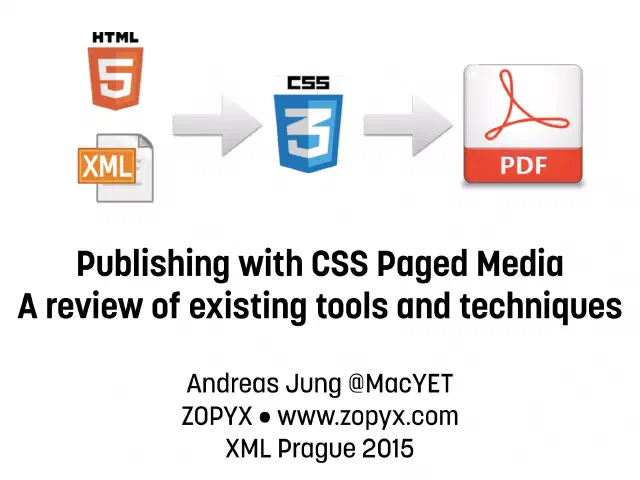
CSS Paged Media - A review of tools and techniques

Das Dokument bietet eine umfassende Analyse der Tools und Techniken zur Veröffentlichung mit CSS-gesteuerten Seitenmedien, einschließlich einer Kritik an XSL-FO und der wachsenden Akzeptanz von CSS in der Verlagsbranche. Es werden verschiedene unterstützte Publikationstypen, relevante Tools und CSS-Regeln zur Formatierung von Inhalten beschrieben. Es wird auch auf die Einschränkungen und Anwendungsfälle von CSS-Paged Media eingegangen sowie auf die Integration von Javascript zur dynamischen Inhaltsbearbeitung.

2015 ·Internet

31499 views·slide text·original files

026 EN · 47 slides

Plone Integration with eXist-db - Structured Content rocks

This document discusses integrating the eXist-db XML database with Plone. It presents an XML-based workflow for publishing medical guidelines, including converting documents to XML, storing them in eXist-db with a structured folder structure, and mapping that structure to Plone using a custom content type. This allows managing XML documents and assets in eXist-db while surfacing them through Plone. The integration provides benefits like improved production safety, validation, and a smaller codebase compared to the original HTML-based system.

2014 ·Internet

2747 views·slide text·original files

027 EN · 48 slides

Why Plone Will Die

This document discusses reasons why the author believes Plone may decline or become a "CMS zombie" unless changes are made. Key points include: Growing developer and integrator frustration due to legacy code, complexities, lack of documentation and APIs. Difficult and unpredictable migrations between major Plone versions that introduce issues and costs. Stagnating community and market as Plone relies on aging technologies like Zope and ZODB. The author argues Plone needs to remove legacy code, simplify architectures, introduce explicit APIs, support new databases and Python 3 to thrive in the future. A potential approach is starting from scratch with Pyramid and new components rather than continuing to build on aging foundations.

2014 ·Internet

6518 views·slide text·original files

028 DE · 26 slides

Onkopedia - Ein medizinisches Leitlinienportal auf dem Weg zu XML-basierten Publishing Workflows

Das Dokument beschreibt den Umstieg auf einen XML-basierten Publishing-Workflow im medizinischen Bereich, insbesondere für das Onkopedia-Portal, das evidenzbasierte Leitlinien zur Krebsbehandlung bereitstellt. Es erläutert den Workflow von der Erstellung von Manuskripten in Word über die Umwandlung in XML bis hin zur Veröffentlichung von PDF-Dokumenten. Die Umstellung auf XML soll eine bessere Automatisierung, Validierbarkeit und Strukturierung der Inhalte ermöglichen.

2014 ·Internet

2324 views·slide text·original files