Keyword index

Plone

7 talks · all tags

002 DE · 27 slides

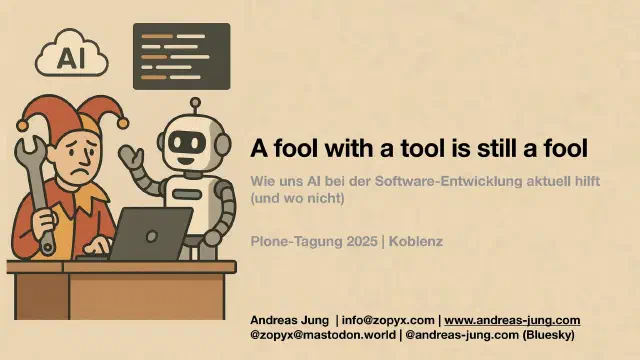
A fool with a tool is still a fool - Plone Tagung 2025 in Koblenz

AI in der Software-Entwicklung - Erfahrungsbericht Vortrag von Andreas Jung auf der Plone-Tagung 2025 in Koblenz Kernaussage "A fool with a tool is still a fool" - AI-Tools sind mächtige Hilfsmittel, ersetzen aber nicht fundiertes Software-Engineering-Wissen. Drei Praxisprojekte 1. Green Energy Herkunftsnachweise (2024-2025) Problem: Schlecht strukturierte FastAPI-Anwendung (10.000 LoC) von Junior-Entwickler AI-Einsatz: GitHub Copilot für Unittests, Dokumentation und Integrationstests Ergebnis: Testabdeckung von 60% auf 92% gesteigert, deutlich bessere Codequalität 2. Wasserstoffverteilnetze-Simulation (Q2/2025) Herausforderung: 7.500 LoC chaotischer Code von Physikern/Data Scientists, fast keine Tests AI-Tool: Claude Code (Anthropic CLI-Tool) Erfolg: 280 Unit Tests generiert, 95% Testabdeckung, automatische Dokumentation Kosten: ca. 30€ AI-Kosten bei enormer Zeitersparnis 3. Plone 4→6 Migration (Uni Saarland) Aufgabe: Webshop-Migration mit Frontend/Backend-Sanierung AI-Nutzen: Terraform/Ansible-Konfiguration, JavaScript-Modernisierung, Bootstrap 5-Migration Positive Aspekte von AI-Tools Automatische Dokumentation fachfremden Codes Generierung von Tests für Qualitätssicherung Bootstrapping neuer Projekte Vereinfachung repetitiver Refaktorierungsaufgaben Zugänglichkeit fachfremder Technologien Produktivitätssteigerung und Zeitersparnis Problematische Seiten Generierung veralteten Codes (besonders ChatGPT) Halluzinationen und falscher Code AI kann sich in Sackgassen verrennen Partielle Verantwortungsabgabe an AI Aktuelle Grenzen (Anti-Patterns) ❌ Software-Architektur in größeren Projekten ❌ Große Refactorings ❌ Umfangreiche unkontrollierte Änderungen ❌ Eigene Fehler erkennen und korrigieren Fazit AI-Tools bieten enormes Potenzial für Produktivitätssteigerung, erfordern aber verantwortungsvollen Umgang und fundierte Software-Engineering-Kenntnisse. Schulungen für Nicht-Entwickler sind essentiell.
2025 ·Software

83 views·slide text·original files

005 EN · 11 slides

Typesense Plone Integration Plone Conference 2022 Namur

The document presents Typesense, a new fault-tolerant full-text search solution designed for Plone 6, offering customizable, high-quality search results and easy integration. It highlights deployment options, including on-premise, private cloud, and Typesense Cloud, along with a demo showcasing user-friendly search templates and widgets. The solution combines features similar to collective.solr and eea.facetedsearch, emphasizing its open-source nature and requirement for user configuration through JavaScript.

2022 ·Software

40 views·slide text·original files

009 EN · 29 slides

Plone 5.2 migration at University Ghent, Belgium

The document outlines the migration process of Ghent University's website from Plone 4.3 to Plone 5.2 using Python 3, detailing various migration strategies, encountered challenges, and the involvement of a dedicated migration team. Key components include the use of ArangoDB for data migration, the creation of a custom migration script, and the need for extensive testing and quality control throughout the process. The current status indicates that content migration is almost complete, with ongoing tasks including testing and theme integration.

2019 ·Internet

893 views·slide text·original files

011 EN · 7 slides

Plone migrations using plone.restapi

This document discusses migrating 10 Plone sites from Plone 4.1/4.3 to Plone 5.1 using plone.restapi. The goals were a consistent look and feel, common code base with fewer dependencies, and consistent deployment. A custom provisioning API was built to handle site creation, content migration, and other tasks. The migration process extracted content from source sites and recreated it in the target Plone 5 sites using plone.api calls over HTTP. Most structures and content migrated automatically, with some manual work needed for default pages, collections, and other content. Lessons learned were that the approach was stable, reasonably fast, and could be adopted for other migrations.

2018 ·Internet

768 views·slide text·original files

021 DE · 37 slides

XML Director - the technical foundation of onkopedia.com

Das Dokument beschreibt das Projekt 'Onkopedia', ein medizinisches Fachportal für Behandlung und Diagnosestandards bei Krebs, betrieben von der Deutschen Gesellschaft für Hämatologie und Medizinische Onkologie. Es erläutert den Publikationsworkflow, der von Word-Dokumenten über XML-Formate bis hin zu PDF-Konversionen reicht, sowie die Vorteile der Umstellung auf XML zur Verbesserung der Qualitätssicherung und der Automatisierung. Darüber hinaus werden die verwendeten Technologien und das Framework für zukünftige Publikationsprojekte dargelegt.

2016 ·Software

1476 views·slide text·original files

027 EN · 48 slides

Why Plone Will Die

This document discusses reasons why the author believes Plone may decline or become a "CMS zombie" unless changes are made. Key points include: Growing developer and integrator frustration due to legacy code, complexities, lack of documentation and APIs. Difficult and unpredictable migrations between major Plone versions that introduce issues and costs. Stagnating community and market as Plone relies on aging technologies like Zope and ZODB. The author argues Plone needs to remove legacy code, simplify architectures, introduce explicit APIs, support new databases and Python 3 to thrive in the future. A potential approach is starting from scratch with Pyramid and new components rather than continuing to build on aging foundations.

2014 ·Internet

6518 views·slide text·original files

041 EN · 28 slides

Frequently asked questions answered frequently - but now for the last time

This document contains a transcript of a talk given by Andreas Jung about frequently asked questions (FAQs) on IRC and mailing lists regarding Plone. The talk provides answers to common Plone questions around topics like installing themes, changing logos, system requirements, debugging issues, and more. It emphasizes best practices for asking questions like providing context and version details. The speaker has extensive experience with Python, Zope, and Plone development.

2009

1590 views·slide text·original files